To Read Charts: Read and Analyze charts
using advanced technical tools
To Time The Market: Maximize profits
by identifying key entry and exit points
To Identify Trends : Isolate trends
to track and gauge their strength
To Understand Currency Pairs: Understand
the unique behavior of each currency pair and
the economic forces that drive currency movements
Real Strategies: Use time tested strategies
and techniques taught by experienced traders
The “Intensive?FX Power course consists of 8 lessons.
This course covers the main aspects of trading in
a very time-efficient manner. Below is an outline
documenting the material that the 8 lessons will cover,
and what students can expect to learn in each segment.
Intensive FX Power Course
Syllabus
Description
I.
Technical Analysis ?Days 1-5
1.
Welcome to the FX Power Course 2. Candlestick
& Other Chart Patterns 3. Fibonacci
Retracements and Moving Averages 4.
Oscillators (RSI and MACD) 5. Stochastics
& Bolliner Bands
Technical analysis of charts is extremely
useful for both long term and short term trades.
We will review these important indicators and
demonstrate how to combine them on the same chart
in order to make effective trades. During this
segment it will be especially important to practice
actively with a demo account in order to familiarize
yourself with the different indicators and to
learn the market conditions where they are most
useful.
II.
Fundamental Analysis ?Days 6-7
6. Who and What Moves the Forex
Market 7. Correlation between Forex
and other Markets
This segment discusses the relevance of economic
data for both long term and short term trading
strategies.
III.
Money Management and Review - Day 8
8. Money Management
Review
This final segment will review the importance
of proper money management. A lot of bad luck
and even poor analysis can be overcome if you
are following the rules of money management and
trading psychology outlined in this lesson. We
will also review the trades you have made in the
course, both good and bad, and point out where
different choices could have been made. Finally,
if you have any questions, you will be free to
ask the instructors.
The “Classic?FX Power Course consists of 22 lessons
that will help you learn how to take advantage of
trading opportunities in the forex market. Below is
an outline documenting the material that the 22 lessons
will cover, and what students can expect to learn
in each segment.
Classic FX Power Course
Syllabus
Description
I.
Introduction to the Forex Market ?Days 1-2
1. Welcome to the FX Power Course 2. Nuts and Bolts of Trading
This first segment will be a summary of the
market, how to physically trade, and the major
market participants.
II.
Technical Analysis ?Days 3-11
3. Intro to Technical Analysis 4. Candlestick Patterns 5.
Fibonacci Retracements 6. Moving Averages 7. Relative Strength Index 8.
Bollinger Bands 9. Moving Average Convergence/Divergence 10. Stochastics 11. Technical
Analysis Wrap Up
This segment is the bulk of the course. Technical
analysis of charts is extremely useful for both
long term and short term trades. We will review
these important indicators and demonstrate how
to combine them on the same chart in order to
make effective trades. During this segment it
will be especially important to practice actively
with a demo account in order to familiarize yourself
with the different indicators and to learn the
market conditions where they are most useful.
III.
Fundamental Analysis ?Days 12-15
12. Who Moves the Market 13. Long Term Fundamental Analysis 14. Short Term Fundamental Analysis 15. Look Back—Fundamental Analysis
This segment discusses the relevance of economic
data for both long term and short term trading
strategies.
IV.
Money Management and Review ?Days 16-22
16. Money Management 17.
Psychology of Trading 18. Look
Back—Technical Analysis 19. Statement
Review, Day 1—The Bad 20. Statement
Review, Day 2—From the Market Maker 21.
Statement Review, Day 3—Best of the Class 22. Speak Now or Forever Hold Your Peace
This final segment will review the importance
of proper money management. A lot of bad luck
and even poor analysis can be overcome if you
are following the rules of money management and
trading psychology outlined in these lessons.
We will also review the trades you have made in
the course, both good and bad, and point out where
different choices could have been made. Finally,
if you have any questions, you will be free to
ask the instructors.
If you have any questions about the course material, please
feel free to contact a Course Specialist. Course Specialists
are available 24 hours a day, 7 days a week. Click
here for contact information.











 To Read Charts: Read and Analyze charts
using advanced technical tools
To Read Charts: Read and Analyze charts
using advanced technical tools 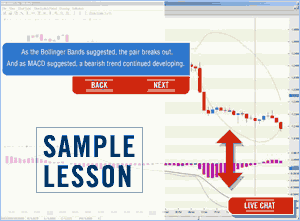
 Intensive FX Power Course
  Technical analysis of charts is extremely
useful for both long term and short term trades.
We will review these important indicators and
demonstrate how to combine them on the same chart
in order to make effective trades. During this
segment it will be especially important to practice
actively with a demo account in order to familiarize
yourself with the different indicators and to
learn the market conditions where they are most
useful.
Technical analysis of charts is extremely
useful for both long term and short term trades.
We will review these important indicators and
demonstrate how to combine them on the same chart
in order to make effective trades. During this
segment it will be especially important to practice
actively with a demo account in order to familiarize
yourself with the different indicators and to
learn the market conditions where they are most
useful.